

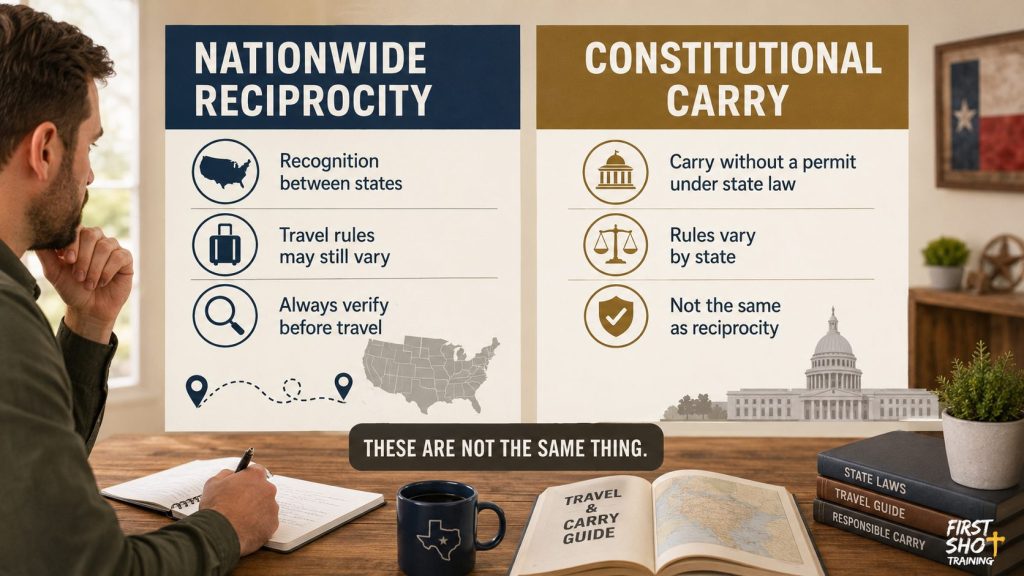
Nationwide reciprocity and constitutional carry both show up in political talk about carrying firearms across state lines. They are related. They are not the same topic.
Quick answer: Nationwide reciprocity would mean states recognize carry privileges from other states. Constitutional carry means eligible people may carry without a permit under certain conditions. Neither exists in federal law today. As of July 2026, Congress has not enacted either one.
What Is Concealed Carry Reciprocity?
Reciprocity is about recognition. It asks whether one state recognizes a license or carry privilege issued by another state. Current reciprocity rules vary by state and change. Check them before you travel.
Federal reciprocity proposals would create a national framework for recognition. The details decide what such a law would actually do. Check whether a proposal covers licenses only, permitless carry states, nonresidents, school zones, and restricted locations.
What Is Constitutional Carry?
Constitutional carry is the everyday phrase for permitless carry. It means eligible people can carry without a license in certain circumstances. Rules still apply, and locations are not all treated alike.
Where Federal Law Stands Today
This is the part most articles skip. No federal law currently creates nationwide reciprocity, and no federal law currently creates nationwide constitutional carry. Bills have been introduced. That is a different thing. Maybe you arrived here after a headline about a nationwide constitutional carry push. In that case, here is what has actually been proposed and what it would mean for Texas.
Here is the status of the three main bills in the 119th Congress. That Congress runs from 2025 through 2026.
- Reciprocity, House. H.R. 38, Constitutional Concealed Carry Reciprocity Act of 2025. Sponsor Rep. Richard Hudson. Introduced January 3, 2025. Ordered reported by the House Judiciary Committee on March 25, 2025. Reported October 3, 2025 as House Report 119-337 and placed on the Union Calendar. No House floor vote.
- Reciprocity, Senate. S. 65, Constitutional Concealed Carry Reciprocity Act of 2025. Sponsor Sen. John Cornyn of Texas. Introduced January 9, 2025. Read twice and referred to the Senate Judiciary Committee. No further action.
- Permitless carry. H.R. 645, National Constitutional Carry Act. Sponsor Rep. Thomas Massie. Introduced January 23, 2025. Referred to the House Judiciary Committee. No further action.
Watch the Congress Number
Bill numbers get reused. This trips people up constantly.
Take H.R. 38 in the 115th Congress. That was the Concealed Carry Reciprocity Act of 2017. It passed the House on December 6, 2017 by a vote of 231 to 198. The Senate received it the next day and sent it to committee. The Senate never passed it. It did not become law.
H.R. 38 in the 119th Congress is a separate bill with the same number. When you read that H.R. 38 passed the House, check which Congress the article means.
The safest habit is to look the bill up yourself. Every bill has its own page at congress.gov showing its sponsor, its actions, and its current status.
Last verified: July 27, 2026, against the official bill records at congress.gov. Federal bill status can change at any time.
Why People Mix Them Up
People mix these terms because both involve public carry and both come up in national politics. Reciprocity is about recognition across state borders. Constitutional carry is about whether a permit is required at all.
Treat one term as the other and you will misread the law.
When you are ready to move from research to action, First Shot Training can help you begin online.
Why This Matters for Texas LTC Students
Texas LTC students care about reciprocity because they travel. They care about constitutional carry because Texas has permitless carry. Knowing both terms helps you ask better questions instead of trusting a vague online summary.
Treat travel, reciprocity, and federal law as topics to re-check often. These rules change, and the official source is the one that counts.
Frequently Asked Questions
Is reciprocity the same as constitutional carry?
No. Reciprocity is about recognition across states. Constitutional carry is about carrying without a license under certain conditions.
Would reciprocity make a Texas LTC more valuable?
It could, if such a law were ever enacted. None has been. Today the value of a Texas LTC for travel comes from the existing state-by-state agreements on the Texas DPS reciprocity chart, not from federal law.
Would constitutional carry remove all restricted locations?
Do not assume that. Restricted locations, federal law, and private property rules are separate requirements.
Why should Texans learn this before traveling?
Travel crosses jurisdictions. Knowing the difference between license recognition and permitless carry tells you what to check before you go.

Disclaimer: The information provided in this article is for general educational and informational purposes only and should not be considered legal advice. First Shot Training is not a law firm and does not provide legal advice. While we make every reasonable effort to ensure the information we publish is accurate and up to date at the time of publication, laws, regulations, licensing requirements, reciprocity agreements, and government policies may change without notice. You are responsible for verifying current information with official government sources before relying on any information contained in this article. If you have questions regarding how the law applies to your specific circumstances, consult a qualified attorney licensed in your jurisdiction.