
Many Texans ask what happens if they carry a concealed handgun without a Texas LTC. Texas permitless carry covers some people in some places. It does not cover every person in every setting.
Quick answer: Under Texas permitless carry, some people can carry concealed without an LTC. Trouble starts when a person is prohibited from possessing firearms or is under the required age. It also starts when a person carries in a restricted place, ignores valid notice, or breaks federal law. This article is educational only and is not legal advice.
Your Own Facts Decide the Answer
There is no single yes or no here. The answer depends on your age and your criminal history. It also depends on where you are standing, whether the property owner has posted notice, and on federal law. No article can check those facts for you.
So do not guess. Read the current law at the official source. Take your own legal questions to a qualified attorney.
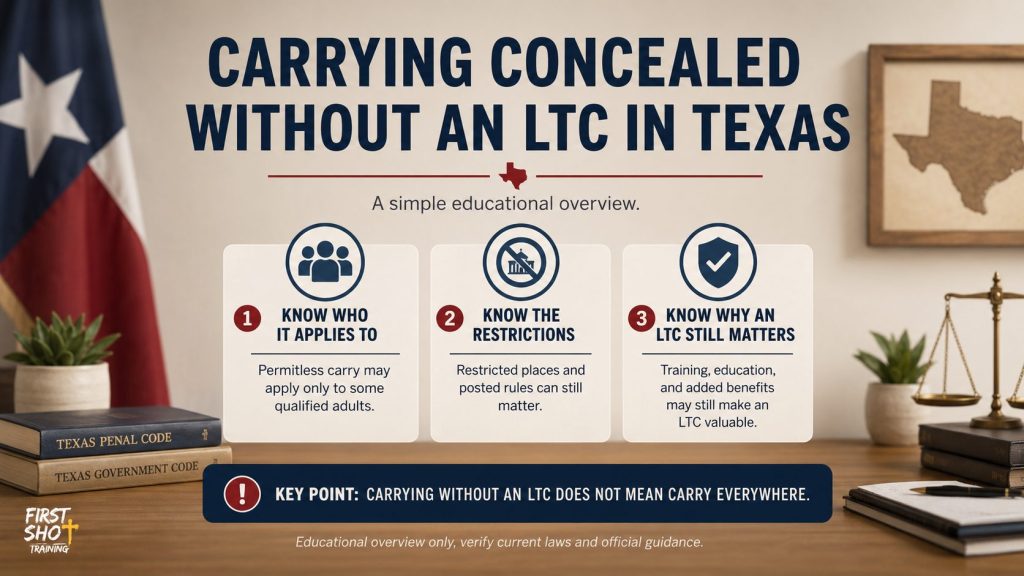
Permitless Carry Does Not Mean Rule Free Carry
Permitless carry lets some people carry without an LTC under certain conditions. It does not erase prohibited places. It does not erase eligibility rules, the rights of property owners, or federal firearm restrictions.
Texas Penal Code Chapter 46 sets out weapons offenses and the places where weapons are prohibited. Texas DPS keeps the official handgun licensing information for anyone pursuing an LTC.
Where Problems Can Commonly Arise
Prohibited person issues
A person who is prohibited from possessing a firearm faces serious criminal consequences. An LTC class cannot decide whether you are eligible. It can show you why that question has to be settled first.
Restricted locations
Some locations have their own rules. Do not rely on memory, a social media comment, or an old summary to decide where those rules apply.
Private property notices
A private property owner can post notice that restricts firearms. The Texas signage rules trip people up, so read what 30.05, 30.06, and 30.07 signs each mean.
Federal law
Federal rules apply on top of state rules. A Texas carry rule does not answer a federal question, such as school zones or federally regulated property.
If you are ready to take the next step, start your Online Texas LTC Class with First Shot Training.
Why an LTC Class Still Helps
The Online Texas LTC Class gives you a structured place to start. It covers terminology, the steps in the process, safety, storage, and how to check official information for yourself.
The class does not provide legal advice or guarantee approval. It helps students start with education instead of assumptions.
Frequently Asked Questions
Can someone carry concealed in Texas without an LTC?
Some people can, under Texas permitless carry. Your own facts decide it. Check current law and ask a qualified attorney about your situation.
Can carrying without an LTC still lead to criminal charges?
Yes. Breaking eligibility rules, location restrictions, private property notice rules, or federal law can lead to charges. This article does not assess any specific situation.
Does an LTC make every carry situation simple?
No. An LTC is valuable, but license holders must still understand restrictions, notices, and responsibilities.
Why take an LTC class if I might not need a license?
Many Texans take the class because education helps them understand safety, responsibility, and the licensing process before making decisions.

Disclaimer: The information provided in this article is for general educational and informational purposes only and should not be considered legal advice. First Shot Training is not a law firm and does not provide legal advice. While we make every reasonable effort to ensure the information we publish is accurate and up to date at the time of publication, laws, regulations, licensing requirements, reciprocity agreements, and government policies may change without notice. You are responsible for verifying current information with official government sources before relying on any information contained in this article. If you have questions regarding how the law applies to your specific circumstances, consult a qualified attorney licensed in your jurisdiction.